The Building Layer
You’re building a transaction layer, not a checkout template.
Every element of the checkout experience is configurable. The layout. The option order. The payment structure presentation. The language. The brand. The flow. You decide what every customer sees at every step.

You open it, and you’re looking at a canvas.
On one side, you have building blocks like payment options, headers, descriptions, CTAs, and branding elements. On the other hand, a live checkout canvas. You’re not writing code. You’re assembling the transaction experience the way it should actually feel for your customer.

You drag elements into place.
You reorder the experience. You edit the copy inline. You see exactly what the customer will see as you’re building it. There’s no guessing how it will behave later; it’s already behaving while you’re designing it.

When it feels right, you publish it.
It goes live immediately across every surface: embedded into your website, accessible via SMS link, displayable via QR code, sendable via email, and callable via API. One build. Every touchpoint. Nothing duplicated.
THE ROUTING LAYER
The system chooses the payment structure for you.
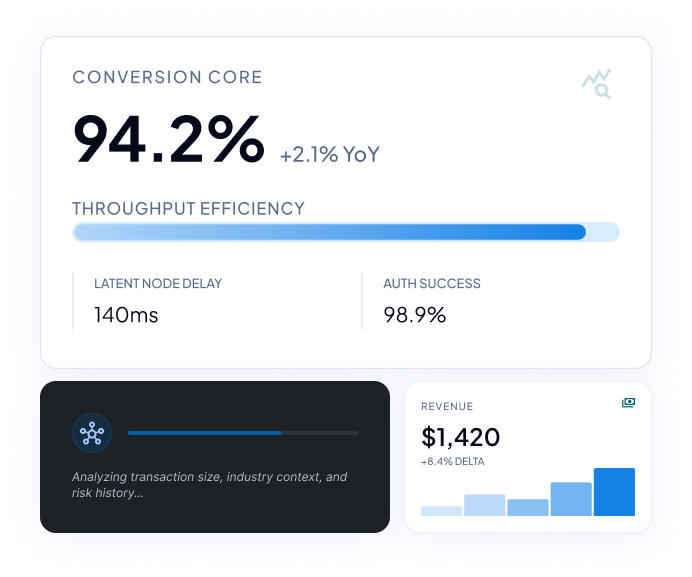
The moment a customer opens checkout, a routing engine is already working. It reads the transaction: the size, the customer behavior, the industry context, the patterns from ten years of similar transactions, and in under a few seconds, it selects the payment path most likely to close. You don't configure this per transaction. It runs automatically on every transaction, from the moment you go live.

It starts working before the customer does
A customer opens your checkout. Before they've made a single choice, the routing engine has already evaluated their profile against the transaction. It knows what similar customers completed. It knows what they didn't. It knows what this transaction size responds to, in your industry.

The system adapts to the customer
The engine selects the optimal path. Not a default. Not a template. The structure most likely to convert this specific transaction, for this specific customer, right now. The payment options that surface, the order they appear in, the structure of how they're presented, all of it reflects that decision.

Every action makes the system smarter
The customer sees a checkout that was built for them. They don't know the routing happened. They just see options that feel relevant. You see a higher completion rate. The system keeps learning from every outcome, making every subsequent routing decision sharper than the last.
THE ANALYSIS LAYER
The system reads the situation, even ‘what fails.’
The moment a customer interacts with your checkout, the routing engine begins its analysis. It is looking at two things simultaneously.

Risk shield before the payment drops
When it identifies a risk signal, it does not wait. It adjusts the transaction structure automatically — before the payment drops. The customer does not notice. The payment has been completed. The revenue is protected.

Auto recovery after the payment drops
When a payment does drop despite Risk Shield, Auto Recovery activates. It follows up according to a sequence built from the recovery patterns that have historically worked best for this transaction type in this industry. It restructures where appropriate. It recaptures silently.
THE INTELLIGENCE LAYER
The system learns from every transaction
The score measures four things simultaneously: your checkout-to-completion rate, your average transaction value relative to the industry benchmark, the exact points where customers drop during checkout, and how effectively failed or abandoned transactions are recovered.
It surfaces the exact change most likely to improve performance based on the historical behavior of similar transactions across the platform. Not — “consider reordering your payment options.” Instead — “moving structured payment options above full payment increased completion rates by 18% across 340 comparable checkouts in your vertical over the last 90 days.
For businesses that want the intelligence layer to go further, Auto-Pilot applies approved optimizations automatically within the rules you define. The system continuously refines payment structures, adjusts checkout presentation, optimizes recovery timing, and improves transaction flows based on live performance patterns. The result is cumulative optimization over time.
Review requests are sent at the statistically optimal moment, not immediately after the transaction, but at the point in the post-transaction window when satisfaction is highest and review completion rates peak. That moment varies by industry. The system knows what it is for you. Payment reminder sequences are timed to the patterns that produce the highest completion rates, and recovery sequences activate the moment a payment drops.
4 intelligence layers.
1000+ behaviors.One question?
What makes a buyer actually finish?